A fusion of lighting design and geometric folding (origami)
Paper lamps
From my experience as an architect, my boundless love for paper and fabric, my all-consuming passion for lighting, or a definite tendency toward minimalism — less, for me, is always more —, I can't say exactly what led me to change careers.
In any case, today, having become familiar with the challenges of geometric folding (a form of origami), I spend most of my time designing and crafting paper lamps.
Since I keep a bit of a distance from the world of design, I would place my approach more on the side of (ethereal) sculpture or (light-based) installation.
This website showcases some of my work. While some of my pieces have been fortunate enough to be exhibited, most are still waiting to be discovered. I am currently focusing on hybrid light fixtures, halfway between a floor lamp and a wall sconce.
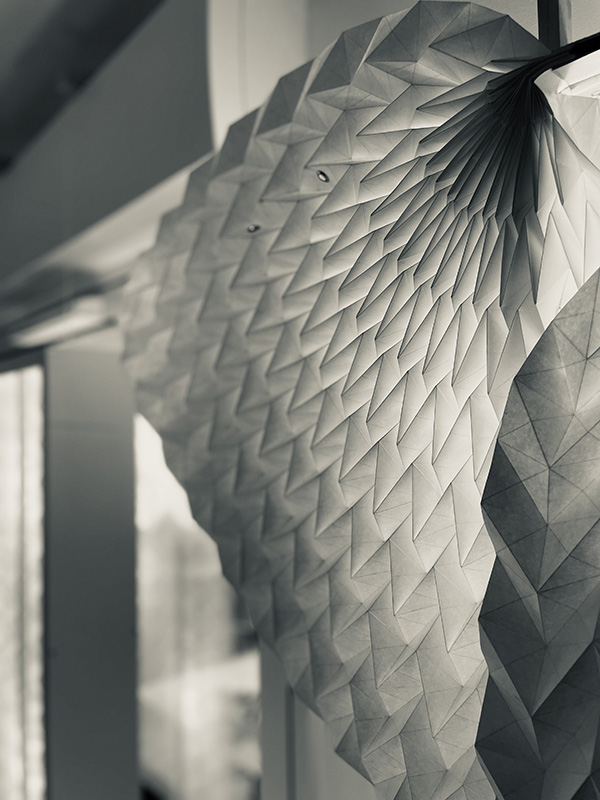
Traditional craftsmanship
Folding paper requires no special talent, just patience and precision; the technique and skill come with time. The folds that inspire me are mostly classics, well known to enthusiasts of geometric origami.
Whether at home, in a restaurant, or in a store, these light fixtures always help create a unique, contemporary atmosphere.
Many thanks to the family of Shuzo Fujimoto (1922–2015) for recently releasing their father’s work into the public domain.
Thanks also to Robert J. Lang, Eric Gjerde, and Ilan Garibi for their valuable research materials.
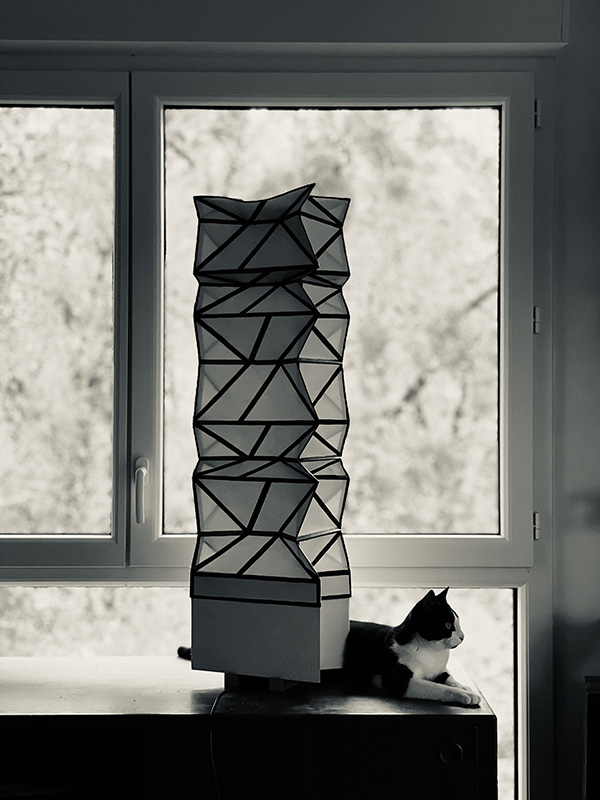
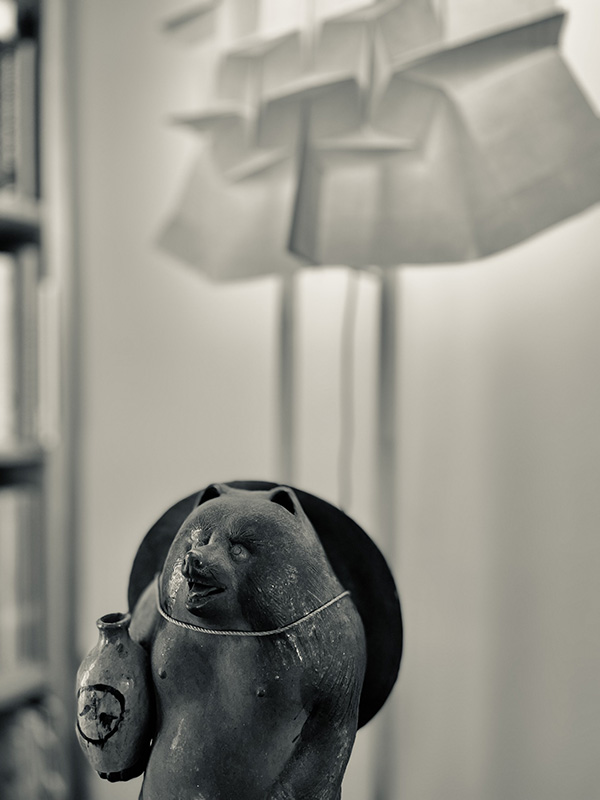
Handcrafted work
Beyond the originality of these creations, the impact of each piece — the result of a long and meticulous artisanal process — stems, despite the special care taken in its creation (folding, sewing, painting, etc.), from an entirely artisanal signature that gives it its unique character.
The paper comes from Germany and is originally intended for bookbinding (long fibers). Once the rectangular dimensions of a sheet have been determined, no cutting or piecing of any kind is performed.
I prefer freehand stitching to the usual collage technique. For large pieces, several sheets are sewn together.
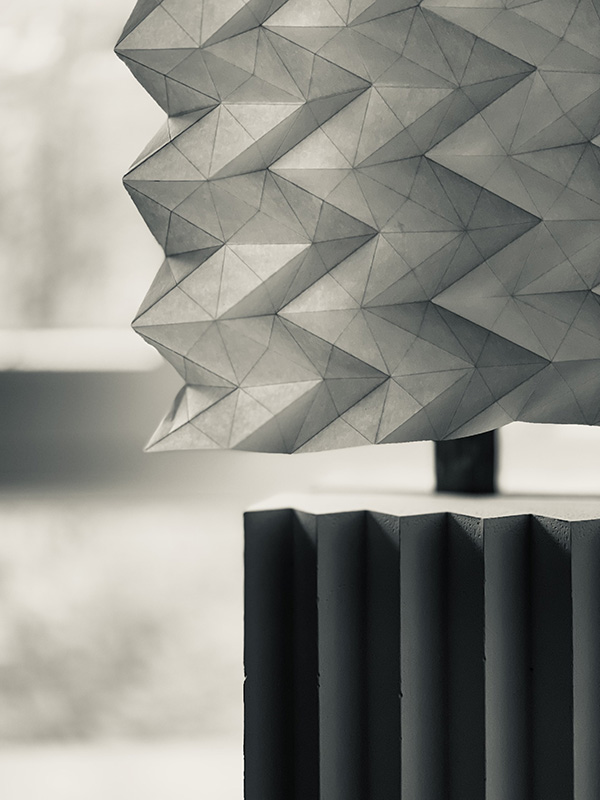
Everyday materials
I mainly use plaster, wood, and paper, which I shape and assemble by hand. The sewing thread is made of wool, silk, or cotton. Sometimes I use metal eyelets or embellish certain pieces with a drawing in India ink. I do not use any plastic except for the electrical wiring (the socket itself is made of metal). All materials used, including the sheets of paper, are durable and sturdy.
The bulbs are E14- or E27-type LEDs; others are T8-type LED tubes mounted in special sockets. Their very low heat output does not damage the paper.
Enjoy your visit!